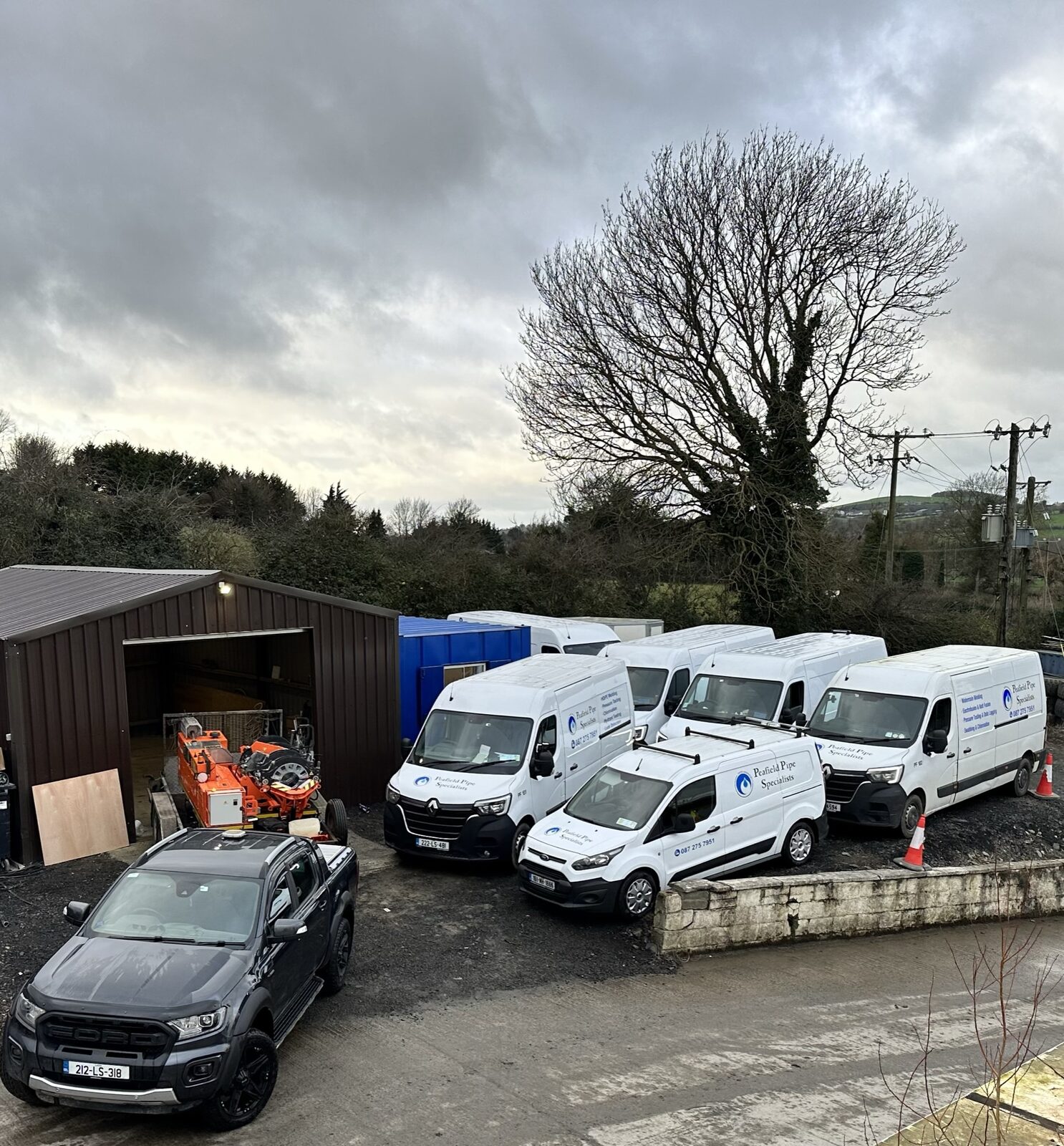
Water Main Commissioning Specialists — Ireland
Peafield Water Management carry out the full commissioning sequence for water mains — cleansing, scouring, swabbing, hydrostatic pressure testing, chlorination, water quality sampling, and preparation of Final Documents for Irish Water Taking in Charge. Based in Co. Laois, working nationwide.
We carry out the complete commissioning sequence for water mains and service connections — from initial cleansing and pressure testing through chlorination, water quality sampling, and preparation of Final Documents required for Irish Water Taking in Charge. All works are in accordance with IW-CDS-5020-03 Code of Practice for Water Supply.
DI and PE water mains tested to IW-CDS-5020-03 and IGN 4-01-03. PrimeLog data logger with hard copy printout for Final Documents.
Read more →Full 24-hour contact period chlorination to IW-CDS-5020-03 §4.10.5 with ISO 17025 accredited water quality sampling.
Read more →Supply and installation of PE100 HDPE and Ductile Iron water mains and service connections. All diameters, all scheme types.
Read more →EF coupler, fitting and saddle jointing of PE80 and PE100 pressure pipelines to WIS 4-32-08. EUSR certified welders.
Read more →HDPE butt fusion from 63mm up to 630mm+ using our Ritmo Remedy fully automatic machines. WIS 4-32-08 compliant.
Read more →Non-invasive tracer gas and acoustic survey on buried gas distribution and transmission networks. Written leak location report.
Read more →Digital noise correlators and ground microphones to pinpoint leaks on buried water mains — no unnecessary excavation.
Read more →Foam swab operations to IW-CDS-5020-03 §4.10.2 and §4.10.4 — pre-chlorination cleansing and post-pressure test swabbing.
Read more →Fire hydrant flow and pressure testing to BS 750 and BS 9990:2015. Full written report per hydrant for Taking in Charge.
Read more →Night flow auditing during the Defects Liability Period to identify leaks in accordance with IW-CDS-5020-03 §4.14.
Read more →Full DLP audit programme from Conformance Certificate through to Completion Certificate application for Irish Water.
Read more →
Peafield Water Management are based in Pike of Rushall, Co. Laois and carry out water main commissioning and leak detection works throughout Ireland — with our main area of work in Dublin and Leinster.
We have spent over 15 years building the expertise and equipment to carry out every stage of the commissioning sequence required under IW-CDS-5020-03 — from initial cleansing, scouring and swabbing through hydrostatic pressure testing, mains chlorination, water quality sampling and preparation of Final Documents for Irish Water Taking in Charge.
We work across all project types — residential developments, local authority schemes, and large-scale commercial, pharmaceutical, and data centre water supply infrastructure. We invest in the most modern data-logging test equipment and fusion welding machines available, and maintain all calibration certificates for inspection at all times on site.
We carry out every stage of the commissioning sequence required under the Irish Water Code of Practice for Water Supply — so your water main can be connected to the Irish Water Network and taken in charge, with all Final Documents in order.
We review the pipe material, diameter, length, and operating pressure to determine the applicable test procedure — Ductile Iron or Polyethylene — and plan the scouring, swabbing, and chlorination sequence.
On completion of construction and before any chlorination, the internal surfaces are cleansed thoroughly by scouring and swabbing. Foam swabs are passed through the Main and recovered. Each swab is used only once. The time, date, number and sizes of swabs introduced and removed are recorded and submitted to the Irish Water field engineer (IW-CDS-5020-03, 4.10.2).
The entire pipeline is pressure tested per IW-CDS-5020-03 (4.10.3) and IGN 4-01-03. The Main is filled with water from the Irish Water Network, air is released, and all valves are checked and sealed. All exposed joints and chambers are visually inspected during the test. A formal test report with hard copy data logger printout is submitted to the Irish Water Field Engineer.
On completion of the pressure test, foam swabs soaked in chlorine are passed through the Main a sufficient number of times to achieve clear wash water (IW-CDS-5020-03, 4.10.4).
A method statement with drawings showing the chlorine insertion point and sample points is submitted to the Irish Water field engineer for approval. The Main is filled with potable water and dosed to a minimum of 20 mg/l free available chlorine (maximum 30 mg/l) using sodium hypochlorite via a calibrated dosing pump. Free chlorine levels are verified at the beginning of the 24-hour contact period using a chlorine comparator test kit. At the end of the contact period, all sample points are re-tested — a minimum of 10 mg/l free chlorine must be maintained (IW-CDS-5020-03, 4.10.5).
All super-chlorinated water is de-chlorinated prior to discharge to sewer or watercourse. Discharge to Irish Water sewers is not carried out without express Irish Water approval. The Main is then flushed with potable water until the free chlorine of the discharge water is within 5% of the incoming feed water. Chlorine residuals are recorded and submitted to the Irish Water field engineer (IW-CDS-5020-03, 4.10.6–4.10.7).
The Main is refilled with potable water and left to stand for 24 hours. On-site checks are carried out for residual chlorine, appearance, taste, and odour. Samples are then taken by trained personnel using aseptic technique and ISO 17025-compliant chain-of-custody tracking, and dispatched to an ISO 17025 accredited laboratory for off-site microbiological and chemical analysis — Coliform Bacteria, E. Coli, Enterococci, Clostridium Perfringens, pH, Turbidity, and Conductivity. Sampling points are submitted to Irish Water field engineer for approval in advance. Connection to the Network is not permitted until a satisfactory result has been received (IW-CDS-5020-03, 4.11).
We prepare and issue the complete suite of Final Documents required for a Conformance Certificate application — including data logger pressure test printouts (with relaxation curve for PE mains), chlorination records, bacteriological sampling results, GPS joint location records, and as-constructed drawings.
From residential developments to critical pharmaceutical and data centre infrastructure — we understand the specific compliance requirements and timelines of every environment we work in.
All works are carried out in full compliance with the Irish Water Code of Practice for Water Supply (IW-CDS-5020-03) and the relevant Irish and British Standards. Full commissioning documentation — test printouts, chlorination records, bacteriological results, and GPS records — is issued on completion of every job.
All works are carried out in full accordance with the Irish Water Code of Practice for Water Infrastructure Connections and Developer Services — Design and Construction Requirements for Self-Lay Developments (IW-CDS-5020-03, Revision 2, July 2020). Pressure testing follows IGN 4-01-03. Final Documents are prepared to the standard required for Conformance Certificate application and Taking in Charge by Irish Water.
All electrofusion and butt fusion jointing of polyethylene pressure pipelines is carried out in accordance with WIS 4-32-08 (Specification for the Fusion Jointing of Polyethylene Pressure Pipeline Systems using PE80 and PE100 materials). All pipe welders are EUSR (Energy & Utility Skills Register) accredited logbook holders with current certification.
Hydrant flow and pressure testing is carried out to BS 750 (Underground Fire Hydrants) and BS 9990:2015. All materials and products in contact with water intended for human consumption are listed in the current edition of the Water Fittings and Materials Directory published by the Water Regulations Advisory Scheme (WRAS), as required under IW-CDS-5020-03 Section 1.5.
Whether you need a pressure test and chlorination for a Taking in Charge submission, a full commissioning programme for a new development water main, or a leak located on an existing supply — call us or send a message and we'll come back to you promptly.